
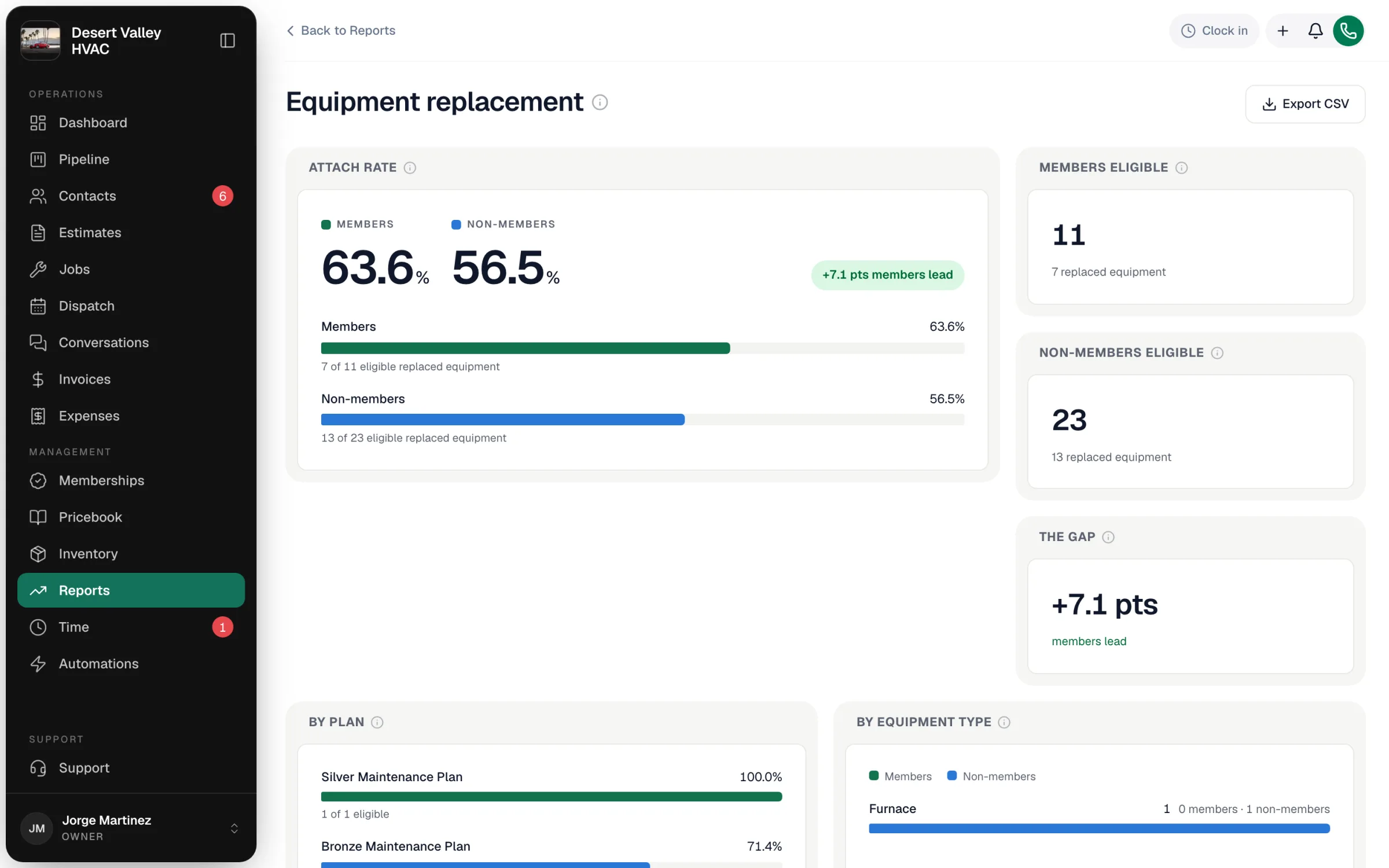
The Equipment Replacement report answers a question every membership program should ask: do members replace their equipment with you more often than non-members? It compares regular customers on the same footing — members against non-members — so you can see whether memberships lead to installs.
Open it from Reports → Memberships → Equipment Replacement. Owners and admins can see it.
How it's calculated
The report always looks back over the last 24 months — there's no date range to pick.
| Term | Meaning |
|---|---|
| Member | A customer who currently has an active membership (including one set not to renew). Everyone else is a non-member. |
| Eligible | A customer with at least three completed or invoiced jobs in the 24 months. One-off customers are left out so the comparison is fair. |
| Replaced equipment | An eligible customer who had at least one Installation job in the same 24 months. |
| Attach rate | Of the eligible customers in a group, the share who replaced equipment. It counts customers, not jobs — a customer with two installs counts once. |
The tiles
| Tile | What it shows |
|---|---|
| Attach rate | The members' rate beside the non-members' rate, with how many of each group replaced equipment. |
| Members eligible | Members with at least three jobs, and how many replaced equipment. |
| Non-members eligible | Non-members with at least three jobs, and how many replaced equipment. |
| The gap | Members' rate minus non-members', in percentage points. Positive means members replace more often. |
| By plan | The attach rate for each membership plan (members only), highest first. |
| By equipment type | How many customers replaced each type of unit (furnace, heat pump, water heater…), split into members and non-members. The type comes from the equipment linked to the installation job. |
Reading it honestly
- Small numbers swing hard. If either group has fewer than 5 eligible customers, the report warns "Small sample" — treat the percentages as a direction, not a verdict.
- New accounts take time. Customers only count after three visits, so most shops start seeing meaningful numbers after about six months of data.
- Members choose to join. Customers who buy a plan were already loyal, so the gap isn't entirely caused by the membership — but it's a useful signal for pricing plans and training techs to sell them.
- Link equipment to installation jobs so the By equipment type breakdown fills in.
Export
Export CSV downloads the member and non-member figures and the breakdowns.