Every tracked part is In stock, Low or Out, based on how many you have and the Low-stock at level you set. Use it as your reorder list: filter to low stock, then place purchase orders.
The three statuses
| Status | When | Dot |
|---|---|---|
| In stock | On hand is above the low-stock level, or no level is set and on hand is above zero. | Green |
| Low | On hand is at or below the low-stock level, and above zero. | Amber |
| Out | On hand is zero or below. | Red |
Examples with Low-stock at set to 5:
| On hand | Status |
|---|---|
| 6 | In stock |
| 5 | Low |
| 0 | Out |
| −2 | Out (more was used than was recorded in stock) |
With no low-stock level, a part is never Low; it goes straight from In stock to Out.
Set the low-stock level
Pick a number that leaves time to reorder before you run out. You can set it in two places:
On the Inventory page: click the part, type the number in Low-stock at and click away. The status updates right away.
In the pricebook: open the part (pencil icon). In its Inventory section, enter Low-stock at. It saves on its own.
Clear the field to remove the level.
Who can do this: owners, admins and dispatchers.
Find parts to reorder
On the Inventory page, open the status filter and choose:
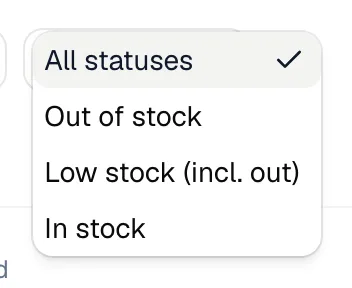
- Low stock (incl. out): everything that needs reordering.
- Out of stock: only parts at zero or below.
Combine it with the category filter to reorder one area at a time. Low and out parts are already sorted to the top of the table.
Good to know
- Warnings appear on the Inventory page only. Run a Call doesn't email you or create purchase orders automatically.
- Receiving a purchase order is how stock goes back up. See How purchase orders receive stock.